
North Pacific Gyre Oscillation
Di Lorenzo Research Group · Brown University
Brown University · Earth, Environmental & Planetary Sciences
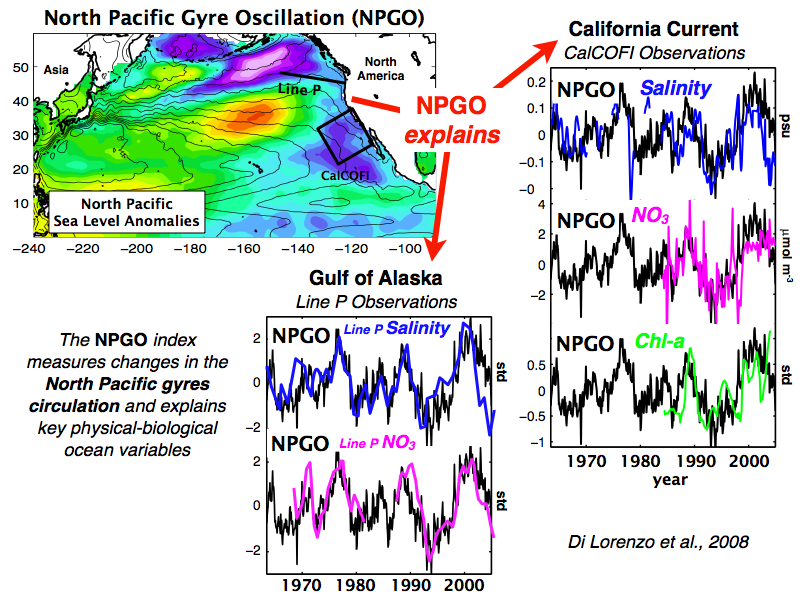
A climate index of North Pacific gyre circulation
The NPGO tracks changes in the strength of the North Pacific gyres — and explains long-standing fluctuations in salinity, nutrients and chlorophyll-a across the California Current and the Gulf of Alaska.
Using the index? Please cite Di Lorenzo et al. (2008), Geophys. Res. Lett.
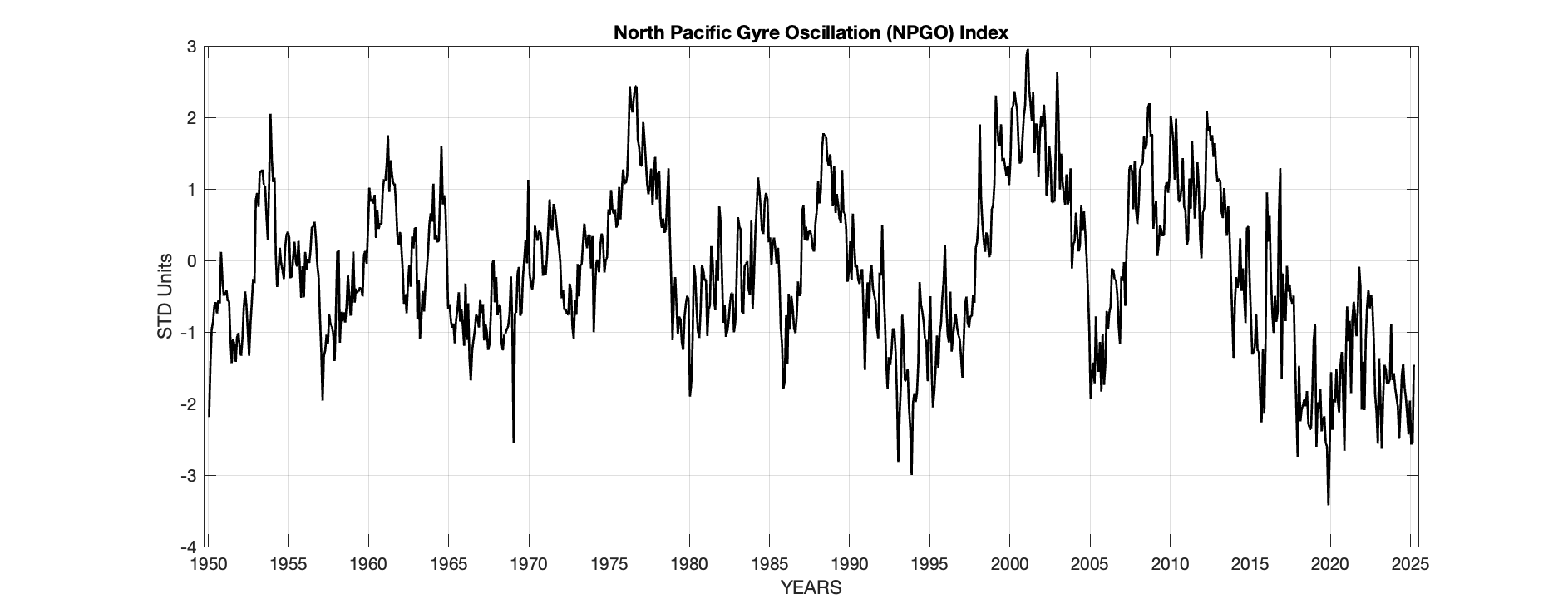
NPGO monthly index · January 1950 – September 2026 · 921 monthly values
About
The North Pacific Gyre Oscillation (NPGO) is a climate pattern that emerges as the second dominant mode of sea surface height variability (2nd EOF SSH) in the Northeast Pacific. The NPGO is significantly correlated with previously unexplained fluctuations of salinity, nutrients and chlorophyll-a measured in long-term observations in the California Current (CalCOFI) and the Gulf of Alaska (Line P).
We use the term NPGO because its fluctuations reflect changes in the intensity of the central and eastern branches of the North Pacific gyre circulations, as evident from the NPGO SSH anomalies. Fluctuations in the NPGO are driven by regional and basin-scale variations in wind-driven upwelling and horizontal advection — the fundamental processes controlling salinity and nutrient concentrations.
Nutrient fluctuations drive concomitant changes in phytoplankton concentrations, and may force similar variability in higher trophic levels. The NPGO therefore provides a strong indicator of fluctuations in the mechanisms driving planktonic ecosystem dynamics.
Data
Monthly values, updated from satellite sea surface height anomalies. Free to use — please cite Di Lorenzo et al. (2008).
Please cite this paper when using the index
The NPGO index and the framework behind it are defined in this paper. If the index appears in your work — in any form — please cite it as the primary reference:
Di Lorenzo, E., N. Schneider, K. M. Cobb, P. J. S. Franks, K. Chhak, A. J. Miller, J. C. McWilliams, S. J. Bograd, H. Arango, E. Curchitser, T. M. Powell and P. Rivière, 2008: North Pacific Gyre Oscillation links ocean climate and ecosystem change. Geophysical Research Letters, 35, L08607, doi:10.1029/2007GL032838.
Methods
A dedicated page documents the full procedure behind every monthly update, so the index can be reproduced or applied to other data sets and to climate-model output.
The second EOF of Northeast Pacific sea surface height, the Copernicus Marine products the update reads, and the eight steps from daily satellite fields to the published value.
Read the method →The fixed spatial pattern that defines the index, on its 255 × 201 grid with an ocean mask, as a NetCDF file usable from Python, MATLAB or R.
Download NPGO_EOF.nc →A short Python script that downloads the satellite data, projects it onto the pattern and reproduces the published values, plus notes on applying the method to model projections.
See the code →Science
Six threads of results linking the NPGO to Pacific decadal dynamics, coastal upwelling and ecosystems.
The decadal dynamics of the Pacific Decadal Oscillation (PDO) and the NPGO are linked through their relationships to ENSO, providing the basis for a framework of quasi-deterministic decadal oscillations of Pacific climate.
View figureThe NPGO closely tracks the second EOF of North Pacific SST anomalies — the “Victoria Mode” (Bond et al., 2003). It is distinct from the PDO, yet it is the dominant mode for salinity and nutrients.
View figureAlong the coast, atmospheric forcing associated with both the PDO and NPGO modulates upwelling cells. The PDO signal is strong north of 38°N; the NPGO is strong south of 38°N along the California Current System.
View figureThe NPGO pattern extends beyond the North Pacific and is part of a global-scale mode of climate variability evident in global sea level trends and sea surface temperature, suggesting coupled tropical dynamics are involved.
View figureThe NPGO is the oceanic expression of the North Pacific Oscillation. Wind-forced sea level anomalies radiate westward Rossby waves that reach the western boundary and modulate decadal variations in the KOE.
View figureThe NPGO controls nutrient and Chl-a variations in the Northeast Pacific, and its large-scale SSH and SST structure is also evident in satellite Chl-a from SeaWiFS — suggesting NPGO-type variability shapes ecosystems basin-wide.
View figureGallery
Click any figure to open it at full resolution.
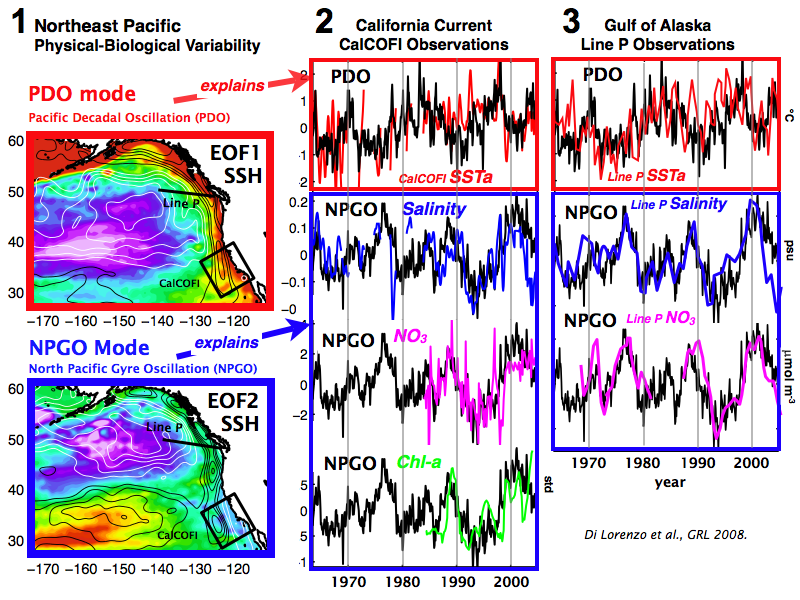 Pacific Decadal Oscillation vs. NPGO
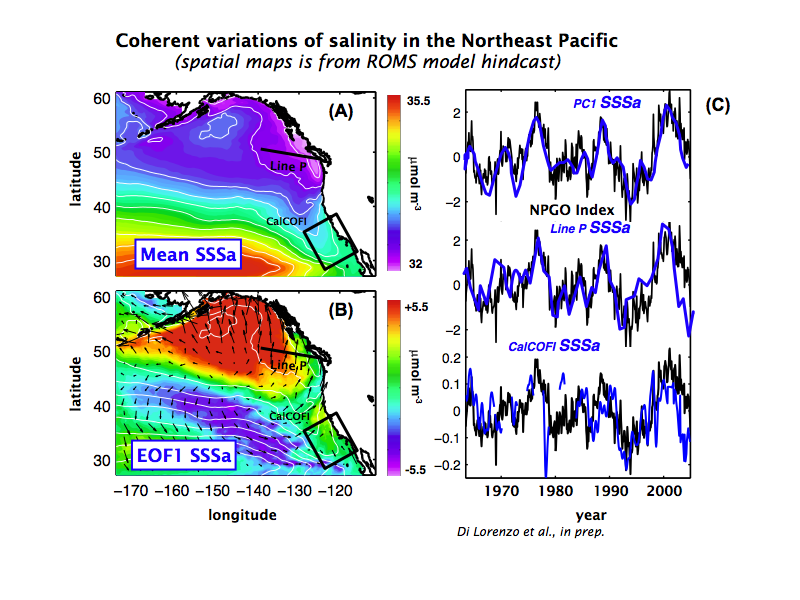 Coherent variations of salinity in the Northeast Pacific
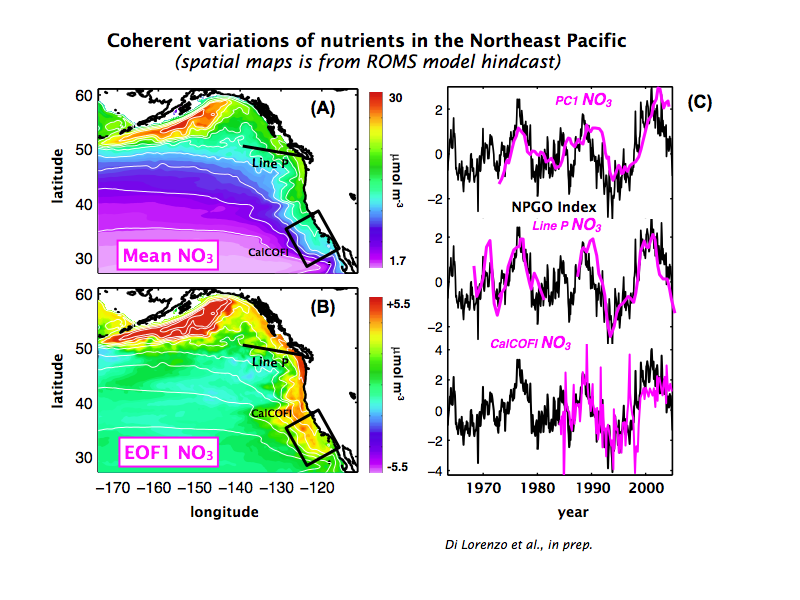 Coherent variations of nutrients in the Northeast Pacific
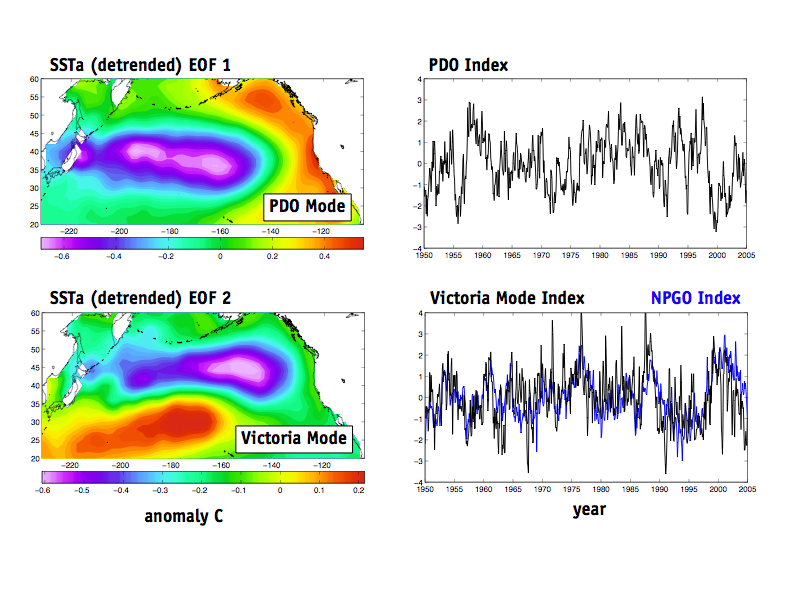 Comparison between the Victoria Mode and NPGO
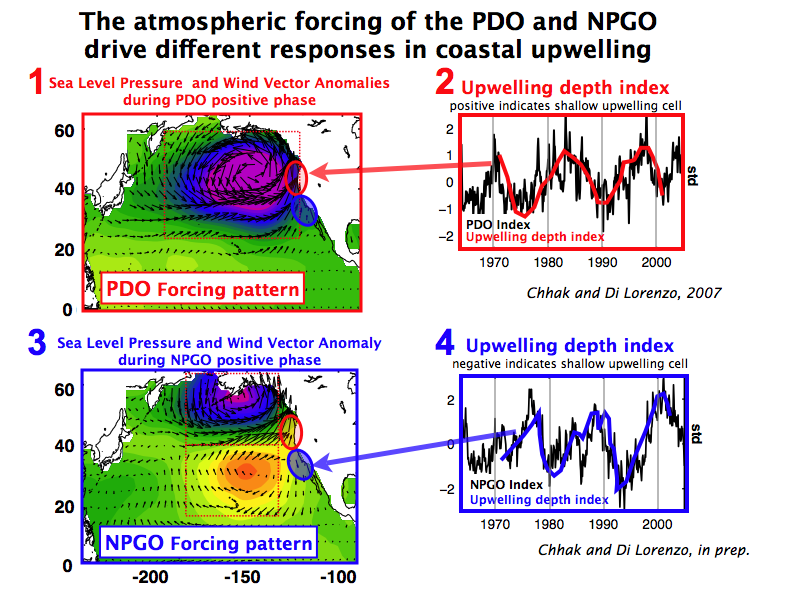 Decadal modulation of eastern-boundary upwelling
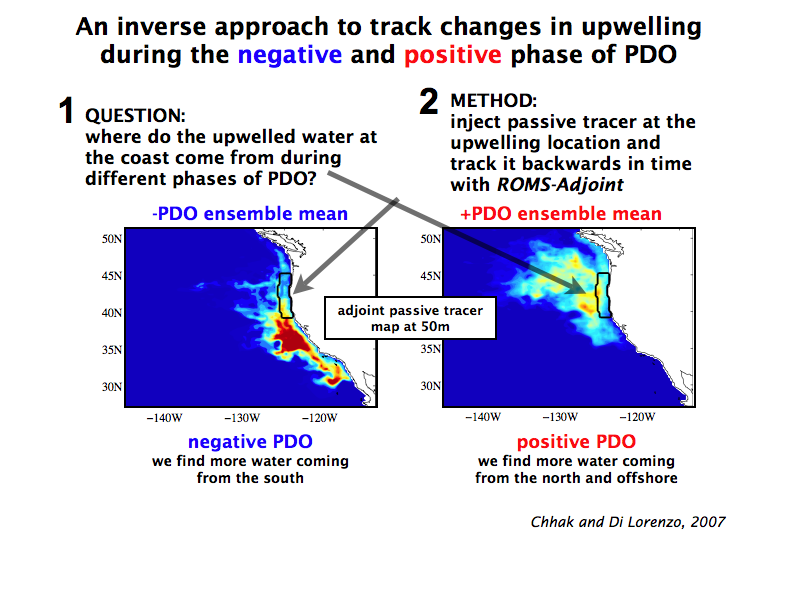 An inverse approach to decadal variations in upwelling
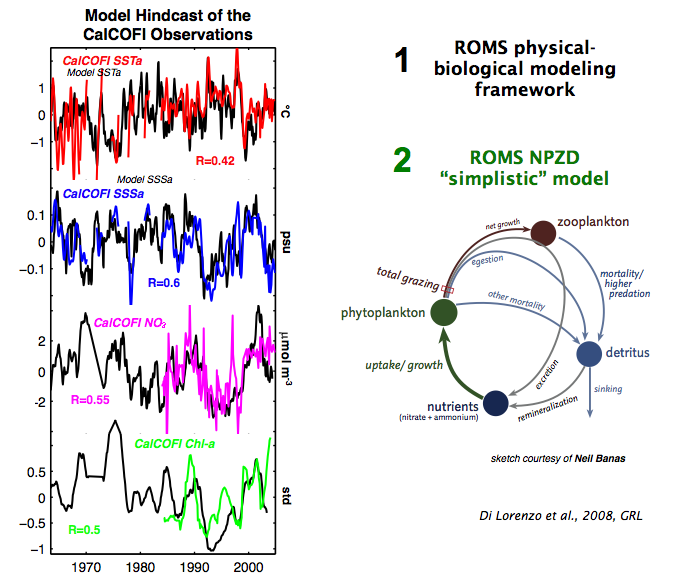 ROMS hindcast 1950–2004 of California Current observations
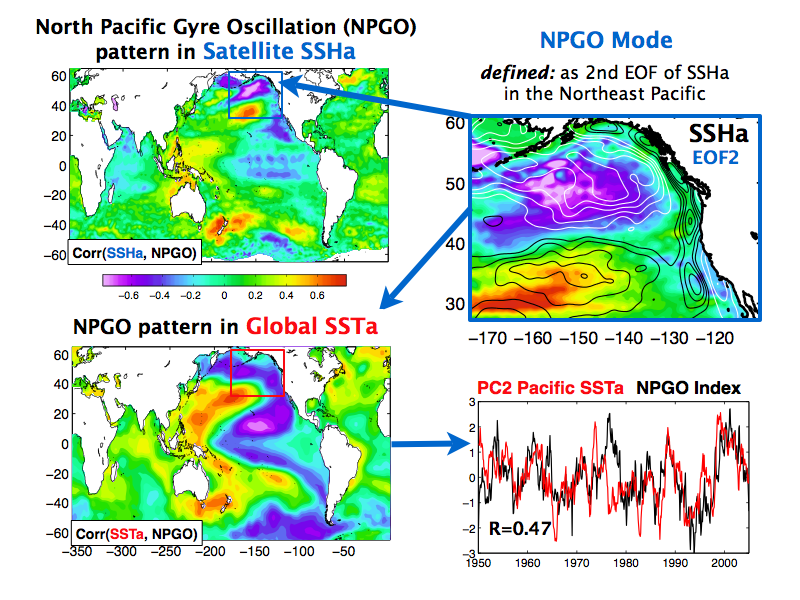 Large-scale patterns of NPGO in SSH and SST
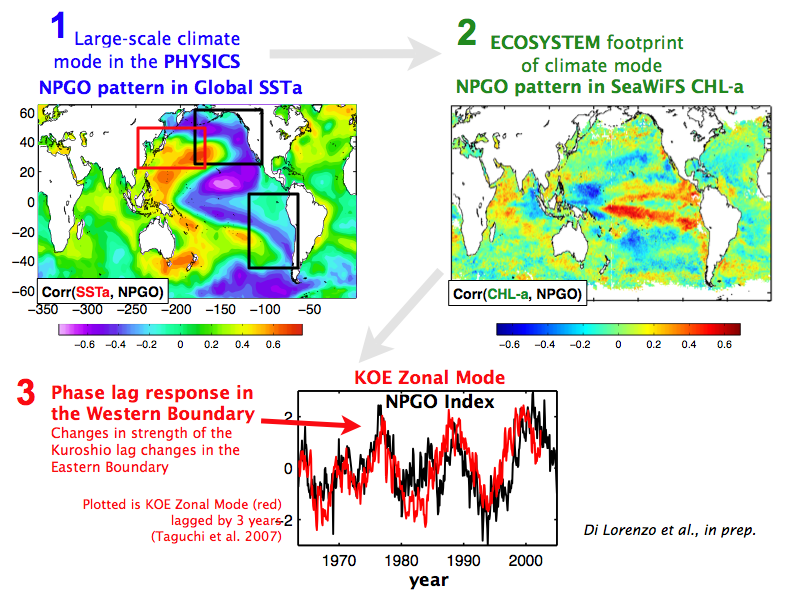 Linking NPGO to large-scale ecosystem variability
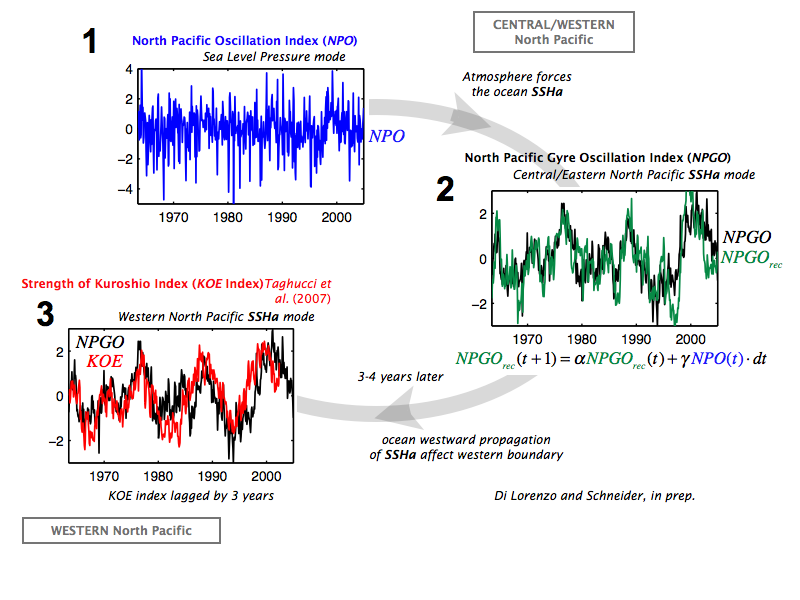 NPGO linked to decadal variations in the KOE
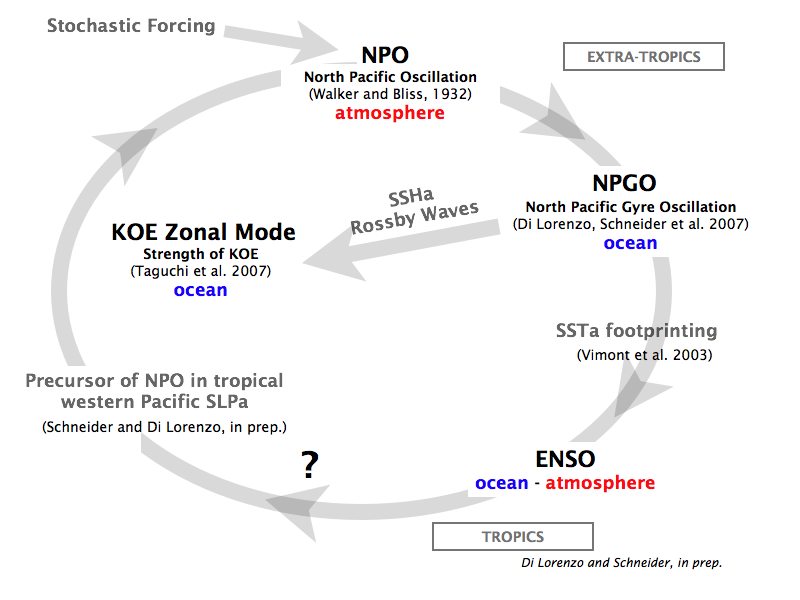 A quasi-decadal deterministic cycle of the Pacific Ocean
 ENSO & NPGO: a framework for Pacific decadal dynamics
Resources
Ceballos et al. · 10 min
Watch (MOV, 10 MB)N. Schneider · presentation recording
Watch (MOV, 11 MB)Full slide deck on the NPGO and Pacific decadal variability
Download (PDF, 8.1 MB)Synthesis of Pacific ecosystem variability
Download (PDF, 6.9 MB)Introductory overview of Pacific decadal variability
Download (PDF, 2.3 MB)The community model used for the California Current hindcasts
Visit myroms.orgPublications
The papers that define the NPGO index and its links to Pacific decadal dynamics, coastal upwelling and marine ecosystems. Full text is available for each.
Primary reference — cite this when using the index
Di Lorenzo, E., N. Schneider, K. M. Cobb, P. J. S. Franks, K. Chhak, A. J. Miller, J. C. McWilliams, S. J. Bograd, H. Arango, E. Curchitser, T. M. Powell and P. Rivière: North Pacific Gyre Oscillation links ocean climate and ecosystem change. Geophysical Research Letters, 35(8), L08607.
Ceballos, L. I., E. Di Lorenzo, C. D. Hoyos, N. Schneider and B. Taguchi: North Pacific Gyre Oscillation synchronizes climate fluctuations in the eastern and western boundary systems. Journal of Climate, 22(19), 5163–5174.
Chenillat, F., P. Rivière, X. Capet, E. Di Lorenzo and B. Blanke: North Pacific Gyre Oscillation modulates seasonal timing and ecosystem functioning in the California Current upwelling system. Geophysical Research Letters, 39, L01606.
Joh, Y. and E. Di Lorenzo: Increasing coupling between NPGO and PDO leads to prolonged marine heatwaves in the Northeast Pacific. Geophysical Research Letters, 44(22), 11663–11671.
Tranchant, B., I. Pujol, E. Di Lorenzo and J. F. Legeais: The North Pacific Gyre Oscillation. Journal of Operational Oceanography, 12(sup1), S29 — Copernicus Marine Service Ocean State Report.
Di Lorenzo, E., T. Xu, Y. Zhao, M. Newman, A. Capotondi, S. Stevenson, D. J. Amaya, B. T. Anderson, R. Ding, J. C. Furtado, Y. Joh, G. Liguori, J. Lou, A. J. Miller, G. Navarra, N. Schneider, D. J. Vimont, S. Wu and H. Zhang: Modes and mechanisms of Pacific decadal-scale variability. Annual Review of Marine Science, 15(1), 249–275.
Di Lorenzo, E., K. M. Cobb, J. C. Furtado, N. Schneider, B. T. Anderson, A. Bracco, M. A. Alexander and D. J. Vimont: Central Pacific El Niño and decadal climate change in the North Pacific Ocean. Nature Geoscience, 3(11), 762–765.
Di Lorenzo, E., G. Liguori, N. Schneider, J. C. Furtado, B. T. Anderson and M. A. Alexander: ENSO and meridional modes: a null hypothesis for Pacific climate variability. Geophysical Research Letters, 42(21), 9440–9448.
Chhak, K. C., E. Di Lorenzo, N. Schneider and P. F. Cummins: Forcing of low-frequency ocean variability in the Northeast Pacific. Journal of Climate, 22(5), 1255–1276.
Furtado, J. C., E. Di Lorenzo, N. Schneider and N. A. Bond: North Pacific decadal variability and climate change in the IPCC AR4 models. Journal of Climate, 24(12), 3049–3067.
Anderson, B. T., D. J. S. Gianotti, J. C. Furtado and E. Di Lorenzo: A decadal precession of atmospheric pressures over the North Pacific. Geophysical Research Letters, 43(8), 3921–3927.
Di Lorenzo, E. and N. Mantua: Multi-year persistence of the 2014/15 North Pacific marine heatwave. Nature Climate Change, 6(11), 1042–1047.
Capotondi, A., M. Newman, T. Xu and E. Di Lorenzo: An optimal precursor of Northeast Pacific marine heatwaves and Central Pacific El Niño events. Geophysical Research Letters, 49(5), e2021GL097350.
Di Lorenzo, E., J. Fiechter, N. Schneider, A. Bracco, A. J. Miller, P. J. S. Franks, S. J. Bograd, A. M. Moore, A. C. Thomas, W. Crawford, A. Peña and A. J. Hermann: Nutrient and salinity decadal variations in the central and eastern North Pacific. Geophysical Research Letters, 36, L14601.
Chhak, K. and E. Di Lorenzo: Decadal variations in the California Current upwelling cells. Geophysical Research Letters, 34(14), L14604.
Di Lorenzo, E. and M. D. Ohman: A double-integration hypothesis to explain ocean ecosystem response to climate forcing. Proceedings of the National Academy of Sciences, 110(7), 2496–2499.
Di Lorenzo, E., V. Combes, J. E. Keister, P. T. Strub, A. C. Thomas, P. J. S. Franks, M. D. Ohman, J. C. Furtado, A. Bracco, S. J. Bograd, W. T. Peterson, F. B. Schwing, S. Chiba, B. Taguchi, S. Hormazábal and C. Parada: Synthesis of Pacific Ocean climate and ecosystem dynamics. Oceanography, 26(4), 68–81.
Cloern, J. E., K. A. Hieb, T. Jacobson, B. Sansó, E. Di Lorenzo, M. T. Stacey, J. L. Largier, W. Meiring, W. T. Peterson, T. M. Powell, M. Winder and A. D. Jassby: Biological communities in San Francisco Bay track large-scale climate forcing over the North Pacific. Geophysical Research Letters, 37, L21602.
Kilduff, D. P., E. Di Lorenzo, L. W. Botsford and S. L. H. Teo: Changing Central Pacific El Niños reduce stability of North American salmon survival rates. Proceedings of the National Academy of Sciences, 112(35), 10962–10966.
Bograd, S. J., C. G. Castro, E. Di Lorenzo, D. M. Palacios, H. Bailey, W. Gilly and F. P. Chavez: Oxygen declines and the shoaling of the hypoxic boundary in the California Current. Geophysical Research Letters, 35(12), L12607.
Capotondi, A., V. Combes, M. A. Alexander, E. Di Lorenzo and A. J. Miller: Low-frequency variability in the Gulf of Alaska from coarse and eddy-permitting ocean models. Journal of Geophysical Research – Oceans, 114, C01017.
Combes, V., E. Di Lorenzo and E. Curchitser: Interannual and decadal variations in cross-shelf transport in the Gulf of Alaska. Journal of Physical Oceanography, 39(4), 1050–1059.